
In April 2026, four astronauts traveled farther than any human has ever gone.
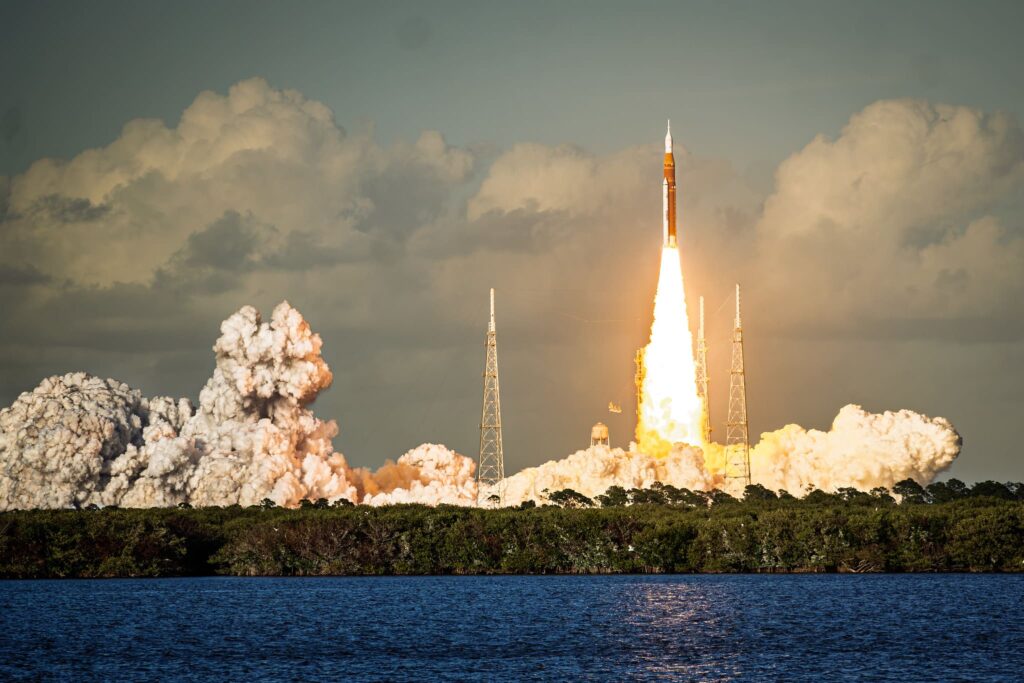
The success of NASA’s Artemis II crewed mission marks a milestone in the history of space exploration, representing the longest and farthest human journey into deep space since the Apollo era. Beyond the media buzz, this achievement validates a software and systems architecture that redefines the limits of modern engineering. This analysis examines how the convergence of computer science, orbital physics, and economies of scale has made this return to the Moon possible.
These Artemis space projects, led by NASA, ESA, and others, have the primary goal of establishing a human presence on our natural satellite, the Moon. This would be achieved through progressive missions of increasing complexity that drive humanity’s technological development. This was the first crewed mission of these Artemis phases.
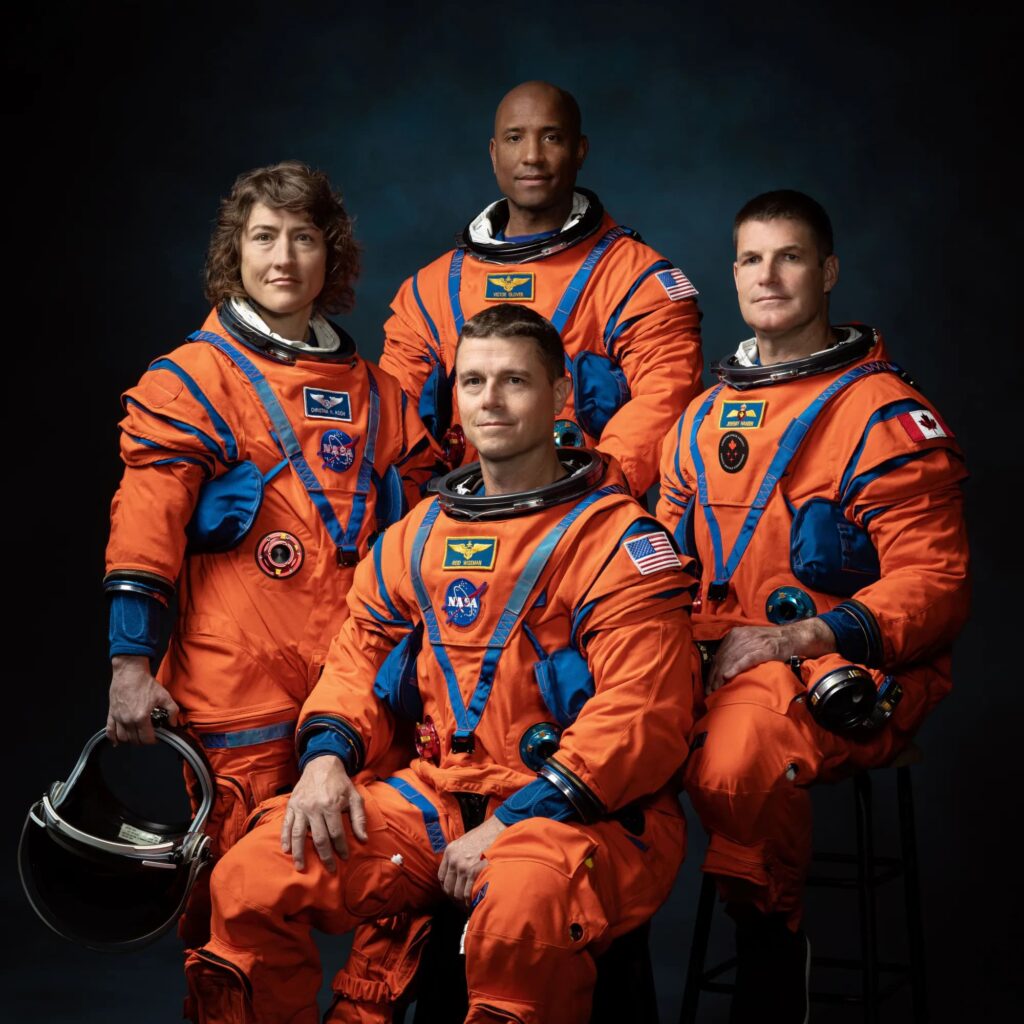
The historic crew of NASA’s Artemis II mission consists of four astronauts.
Below are their full names, military ranks (where applicable), and official designations for the spaceflight:
- Gregory Reid Wiseman
- Rank: Captain (Navy Captain) in the United States Navy.
- Designation: Mission Commander.
- Note: He is the flight leader, responsible for the overall safety of the crew and the execution of the mission.
- Victor Jerome Glover
- Rank: Captain (Navy Captain) in the United States Navy.
- Designation: Pilot.
- Note: Second in command, directly responsible for maneuvering the Orion capsule and controlling dynamic systems during the flight.
- Christina Hammock Koch
- Rank: Civilian (Electrical Engineering).
- Designation: Mission Specialist 1.
- Note: Responsible for monitoring complex systems, managing the payload, and conducting critical scientific experiments on board.
- Jeremy Robert Hansen
- Rank: Colonel, Royal Canadian Air Force.
- Designation: Mission Specialist 2.
- Note: Represents the Canadian Space Agency (CSA) and assists in overseeing flight and life support operations.
Historical and Technological Development: The Evolution of Navigation Computing.
To appreciate the technological leap involved in this mission, it is necessary to compare its infrastructure with the technology used in previous crewed space missions to the Moon, the most recent of which took place in 1969. Thus, the evolution of aerospace systems engineering today is more significant, but it cannot be measured solely by the raw processing power of the processors; rather, it lies in the transition from rigid, monolithic architectures to highly isolated and resilient virtual environments.
The following is a technical overview of the core IT components of both programs:
| Metric / Component | Programm Apollo (AGC) 1969 | Nave Orion (Artemis II) 2026 |
| Processor Frequency | ~2.048 MHz | 2x Procesadores IBM PowerPC de 750 MHz |
| Random Access Memory (RAM) | 2,048 palabras (aprox. 4 KB) | 256 MB por computadora de vuelo |
| Storage Capacity | 36,864 palabras (aprox. 72 KB en ROM) | 256 GB (Memoria Flash de estado sólido) |
| Software Paradigm | Lenguaje Ensamblador (Assembly) | C / C++ bajo estándar ARINC 653 |
| Living Space | 6.2 m³ (Estructura compacta) | 9.3 m³ (57% más de espacio útil) |
Some differences…
1. From Hand-Woven Code to Model-Based Development
The Apollo Guidance Computer (AGC) was a marvel of analog hardware and cutting-edge technology for its time. Its read-only memory (ROM) was physically “wired” using a manual process known as Core Rope Memory, in which skilled seamstresses threaded copper wires through magnetic cores (a wire represented a “1,” and wrapping the wire around the core represented a “0”). The software was written directly in a low-level assembly language optimized to the extreme.
In contrast, the Orion capsule’s software is based on Model-Based Development (MBD) and is written primarily in C and C++. Instead of optimizing individual bytes due to physical constraints, engineers model the behavior of the Guidance, Navigation, and Control (GN&C) system abstractly, generating code in an automated and deterministic manner.
2. Virtualization and Isolation: The ARINC 653 Standard
During the Apollo missions, a memory overflow or data overload in the processor would completely cripple the computer (as happened during the critical incident involving the famous Alarms 1201 and 1202 during the Apollo 11 descent). Orion addresses this risk by implementing the ARINC 653 standard in its real-time operating system. This architecture divides the processor into strictly separated logical sections (partitions). If the software responsible for life support enters an infinite loop or suffers data corruption, the operating system absolutely guarantees that the partitions responsible for propulsion and navigation will continue to receive computing time and memory without being affected. Each partition operates as if it were an independent virtual computer.
3. Logical Redundancy Against Cosmic Radiation
While the Apollo program relied on the simplicity of its individual circuits for safety, Orion must survive in deep space against cosmic radiation impacts, which can cause a critical phenomenon known as a bit flip (the unintended electromagnetic alteration of a bit from 0 to 1).
To mitigate this without resorting to costly, heavily shielded processors, the Artemis architecture uses mirrored redundant computers. The system performs the same calculations on parallel chips and uses a “majority voting” mechanism. If a burst of radiation corrupts the memory of one of the processors, the network cards compare the results within milliseconds, discard the corrupted data from the affected machine, and continue operation without interruption.

The Engineering Research Group: Software Architecture and Real-Time Critical Systems
From a systems engineering perspective, the Orion capsule for the Artemis II mission should not be viewed simply as a transport vehicle, but rather as a high-availability distributed computing environment. Unlike commercial service-oriented systems (where a delay of a few milliseconds represents a minor degradation of service), aerospace systems operate under the Hard Real-Time paradigm, where failure to meet a computation time window can result in catastrophic mission loss.
The software design for this mission is based on three essential architectural pillars:
A. Absolute Determinism and Real-Time Operating Systems (RTOS)
Orion’s flight software does not use conventional operating systems. Instead, it relies on a specialized RTOS (Real-Time Operating System) that guarantees determinism. In traditional computing, task schedulers aim for overall efficiency; in deep space, however, mathematical certainty is required that a critical task—such as trajectory correction using thrusters—will be executed exactly at the planned millisecond.
To achieve this, the code does not use dynamic memory allocation (avoiding functions such as malloc in C++) to prevent RAM fragmentation and ensure that response times are completely predictable from start to finish.
[Datos de Sensores IMU] ──> [Filtro de Kalman / Navegación] ──> [Garantía RTOS < 1ms] ──> [Actuación de Propulsores]
B. Autonomous Life Cycle Management and Life Support (ECLS)
At a distance of more than 400,000 kilometers from Earth, radio communication latency prevents engineers at the Houston control center from responding in real time to a critical emergency. For this reason, the spacecraft’s Environmental Control and Life Support (ECLS) system is governed by autonomous algorithms for fault detection, isolation, and recovery (FDIR).
If a sensor detects a drop in pressure or an abnormal increase in carbon dioxide, the spacecraft’s software does not wait for instructions from the ground:
- Detects anomalies by comparing telemetry data from redundant sensors.
- Isolates the faulty subsystem by closing digital valves or switching to physical backup lines.
- Restores stability to the environment by automating redundancy within milliseconds, reporting the diagnosis to the crew via simplified graphical user interfaces (GUIs) based on modern digital instrumentation.
C. High-Reliability Concurrency and Data Buses
It was an enormous challenge to maintain communication with the spacecraft as it moved farther and farther away from Earth. The interconnection of the spacecraft’s physical components (propulsion, navigation, solar panels, and avionics) requires an internal network that is immune to electromagnetic interference. Orion uses a network standard known as Time-Triggered Ethernet (TTEthernet).
Unlike the standard Ethernet protocol used in home or corporate networks (where data packets can collide and compete for bandwidth), TTEthernet assigns fixed, exclusive time slots for each type of message at the hardware level. This ensures that critical flight control data travels concurrently with secondary telemetry and high-definition video, but with the absolute guarantee that it will never suffer a delay due to congestion on the data bus.
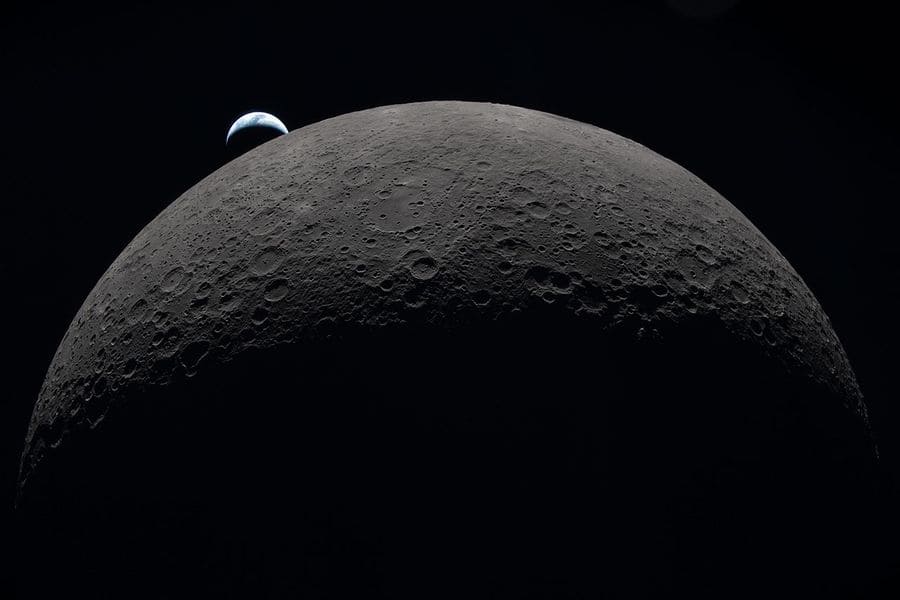
Economic and Geopolitical Impact
The Artemis II mission marks a geopolitical and financial paradigm shift: the transition from a centralized state-run model to public-private partnerships (PPPs). Unlike the Apollo era, which was funded exclusively with taxpayer money during the Cold War, the current program relies on a network of commercial providers such as SpaceX, Boeing, and Lockheed Martin. This structure optimizes public spending through service contracts, reduces operating costs by reusing hardware, and fosters a competitive space economy that promotes the sustainable exploitation of lunar resources.
On the political front, the strategy is structured around the Artemis Accords, an international regulatory framework that promotes peaceful cooperation and technical interoperability. As a result, deep space exploration is no longer strictly a national show of strength but has become a global platform for technological standardization.
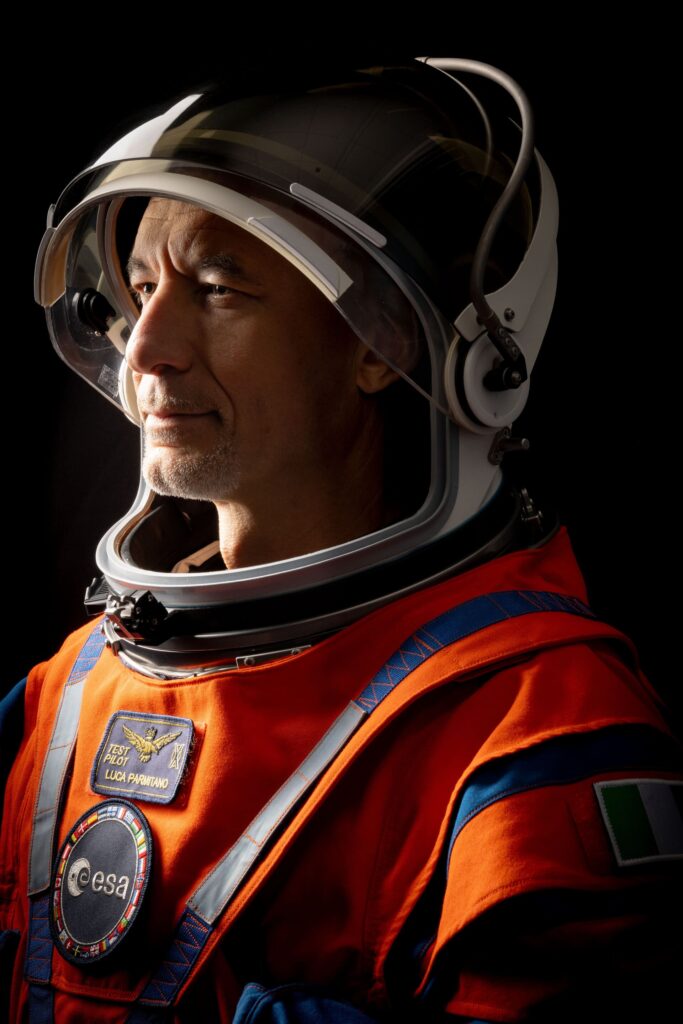
The Artemis II mission demonstrates that the true driving force behind modern space exploration lies not only in the power of chemical propulsion systems, but also in the robustness of the code and the resilience of software architectures. The transition toward autonomous systems, deterministic networks, and fault-tolerant environments defines the contemporary standard of systems engineering. For the computing community, this milestone reaffirms a fundamental premise: software quality and rigorous design of logical infrastructure are the pillars that enable humanity to safely and predictably expand its frontiers beyond Earth. The next Artemis III mission aims to achieve a successful landing on the Moon to construct domes and is already in the planning stages for 2027.
Holiver Hurtado – IT Professional
References / Bibliographies / Appendices
- Fotos: https://science.nasa.gov/earth/earth-observatory/a-moonlit-earth-as-seen-from-artemis-ii/
- Noticias: https://www.nasa.gov/centers-and-facilities/marshall/nasa-names-astronauts-to-next-moon-mission-first-crew-under-artemis/
- https://eol.jsc.nasa.gov/SearchPhotos/ShowQueryResults-Lightcycle.pl?results=Artemis_Artemis2_all
- Documentales: https://www.youtube.com/watch?v=8xCpY5IobrA
- https://cacm.acm.org/news/how-nasa-built-artemis-iis-fault-tolerant-computer/
- https://www.esa.int/ESA_Multimedia/Images/2026/06/Luca_Parmitano_Artemis_III_pilot
Leave a Reply